
Sleep and stress are often discussed like lifestyle preferences: sleep more, stress less, problem solved. Metabolic health does not work that way. From the body’s perspective, sleep and stress describe whether the system is actually allowed to recover.
This hub explains how sleep quality and chronic stress shape the “baseline” for energy regulation, liver workload, and day-to-day stability. The goal is not to provide a long checklist. The goal is to make the system understandable—so later choices (habits, tests, supplements) stop feeling random.
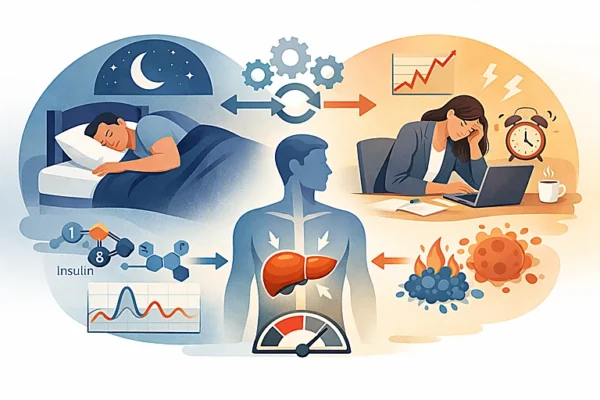
Sleep and Stress Are Two Sides of the Same Recovery System
Sleep and stress are commonly treated as separate topics, but physiologically they overlap. Sleep is the primary recovery window. Chronic stress is the primary recovery blocker. When either is consistently off, the body behaves as if it is operating in a low-level emergency mode: not dramatic, but persistent.
In that mode, the body tends to prioritize short-term function over long-term efficiency. That shift has consequences for metabolism and for organs that act as “buffers,” especially the liver.
For a focused explanation of why sleep quality matters more than total hours, see: Sleep and Metabolic Health: Why Sleep Quality Matters More Than Duration.
Chronic Stress: The Quiet Kind That Never Fully Turns Off
Not all stress is harmful. Short, recoverable stress is a normal part of life. The problem is chronic, low-grade stress that never fully shuts down. This is the kind that often goes unnoticed because it does not always feel emotional. It can be “just how life is.”
Common drivers include:
- Fragmented sleep (even if total hours look “fine”)
- Irregular eating patterns and constant snacking
- Over-caffeination masking fatigue
- Long-term inflammation or illness load
- Persistent high stimulation and no real downshift periods
Over time, this creates a body that is functional but not truly recovered. The result is often a cluster of “nonspecific” issues: unstable energy, cravings, reduced tolerance to training, mood volatility, and inconsistent responses to health interventions.
For a deeper dive into how chronic stress becomes metabolic overload, see: Chronic Stress and Metabolic Overload: When the Body Never Fully Recovers.
Sleep Is a Metabolic Recovery Window, Not Just “Time Off”
Sleep is often described as rest, but metabolically it is active work. During quality sleep, the body performs tasks that are difficult to complete efficiently in waking hours:
- Resetting insulin sensitivity and glucose handling
- Regulating stress hormones and maintaining circadian rhythm
- Rebalancing appetite signaling (hunger and satiety cues)
- Replenishing and managing liver glycogen
- Shifting the nervous system toward repair and maintenance
This is why sleep quality matters so much. A person can spend a long time in bed and still miss the deeper stages of recovery if sleep is fragmented, irregular, or constantly interrupted.
Why Sleep and Stress Often Show Up as “Metabolism Problems” First
When recovery is compromised, the first changes are rarely dramatic. They tend to show up as gradual loss of metabolic flexibility—meaning the body becomes less able to adapt cleanly to normal stressors like missed meals, workouts, late nights, or heavier days of eating.
What this can look like in real life:
- Energy that feels “wired but tired”
- Cravings that spike in the evening
- Weight management becoming harder despite similar routines
- Blood sugar feeling less stable (especially after poor sleep)
- Performance and recovery from exercise becoming unpredictable
None of these prove a single diagnosis. They simply indicate the body is operating with less room for error. When the baseline shrinks, everything feels more reactive.
Why the Liver Often Becomes the “Buffer” That Gets Overworked
The liver is deeply involved in energy regulation, hormone processing, and metabolic housekeeping. It is not only a digestive organ; it is a system stabilizer. When sleep and stress are consistently off, the liver may take on extra load in several ways:
- Managing blood glucose through glycogen storage and release
- Processing stress-related hormonal signals
- Supporting lipid metabolism under less ideal conditions
- Handling higher oxidative and inflammatory byproduct load
This is one reason some people notice fluctuating liver markers even when they do not drink alcohol and are not doing anything obviously extreme. The system may be strained, not “broken,” but the buffer is working overtime.
For a focused explanation of how poor sleep can affect liver function even without alcohol, see: Why Poor Sleep Disrupts Liver Function (Even Without Alcohol).
When the Baseline Is Low, Interventions Become Less Predictable
A common frustration is doing many things “right” and getting inconsistent results. This can happen when the recovery baseline is unstable. In that context, two problems appear:
- Signals get noisy. Hormones and appetite cues fluctuate more, making day-to-day outcomes inconsistent.
- Small stressors hit harder. One late night, one hard workout, or one stressful week can undo progress quickly.
This is not a moral failure and it is not a willpower problem. It is an environment problem inside the body: recovery is not keeping pace with load.
Why Supplements Often Feel “Muted” When Sleep and Stress Are the Bottleneck
Supplements can sometimes help at the margins, but they do not replace the core conditions required for recovery. When sleep is fragmented and stress is chronically elevated, the body may simply be too busy compensating to show clean improvements.
In this scenario, supplement outcomes often look like:
- Helping a little, but not consistently
- Working briefly, then “stopping”
- Seeming to work only on good weeks
This does not mean supplements never make sense. It means their effects are highly dependent on the baseline. If the baseline is unstable, results will be unstable too. This is an explanation, not a judgment.
How to Use This Hub Going Forward
This hub is designed to sit above the details. Readers can use it as a “map” when the next step is unclear. If the goal is to improve metabolic outcomes, it usually helps to ask one basic question first:
Is the body consistently given enough uninterrupted recovery time to reset?
If the answer is “not really,” then the best next step is often to stabilize sleep and reduce chronic load before expecting clean results from optimization strategies. That order is not exciting, but it is efficient.