
When people start thinking about liver health, supplements often appear before lifestyle changes. Capsules feel simple, controlled, and proactive. Diet, sleep, and habits, by contrast, feel vague and harder to measure.
This comparison looks at liver supplements versus lifestyle changes from a practical, non-extreme perspective. The goal is not to dismiss supplements, but to clarify where each approach actually fits—and which usually matters first.
If you are unsure whether liver support is even necessary, it may help to start with a broader decision framework: Do You Actually Need Liver Supplements?.
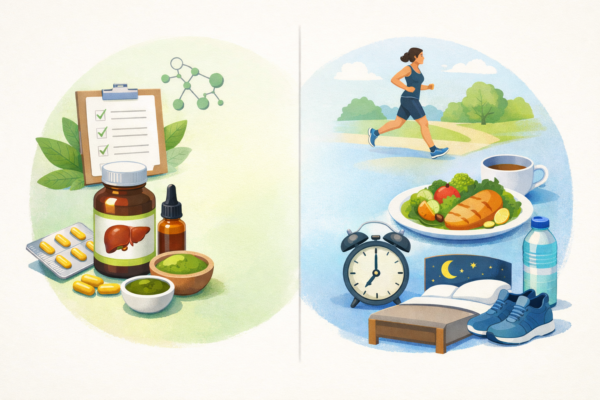
What Lifestyle Changes Affect Liver Health Most
The liver responds strongly to everyday inputs. In many cases, small but consistent lifestyle adjustments influence liver markers more than any supplement.
Sleep Quality and Timing
Sleep is when many repair and metabolic processes occur. Irregular sleep, short duration, or late-night schedules can affect insulin sensitivity, inflammation, and liver enzyme patterns.
A deeper look at this connection is covered in Sleep and Liver Health.
Alcohol Frequency, Not Just Quantity
For most people, how often alcohol is consumed matters more than occasional higher intake. Regular low-level exposure can keep the liver in a constant recovery state.
Diet Consistency Over Perfection
Extreme diets tend to stress metabolism more than help it. Consistent meals, adequate protein, and stable calorie intake usually matter more than short-term cleanses or detox plans.
Stress and Recovery Balance
Chronic stress alters cortisol patterns, which can indirectly affect liver metabolism and fat storage. Lifestyle recovery—rest days, mental downtime, and workload balance—often has measurable downstream effects.
What Liver Supplements Are Designed to Do
Liver supplements are typically formulated to support specific biochemical pathways rather than overhaul overall metabolism.
- Antioxidant support
- Bile production and fat digestion
- Nutrient cofactors involved in metabolism
They are best viewed as targeted tools rather than foundations. A practical overview of how liver support is often misunderstood can be found in Liver Support & Detox Explained.
When Lifestyle Changes Usually Come First
For most healthy adults, lifestyle changes should be prioritized before supplements when:
- Liver enzymes are within normal or borderline ranges
- Sleep quality is inconsistent
- Alcohol intake is regular, even at moderate levels
- Fatigue is linked to stress or poor recovery
In these situations, supplements often add little benefit on top of unresolved lifestyle factors.
When Liver Supplements May Play a Supportive Role
Supplements may make more sense when:
- Lifestyle fundamentals are already reasonably stable
- There is a known metabolic or digestive bottleneck
- Temporary stressors increase liver workload
- Stimulant-based products are poorly tolerated
Even then, supplements rarely replace lifestyle changes—they complement them.
Common Misconceptions About This Choice
“Supplements Are Easier Than Habits”
While supplements are easier to take, they do not bypass poor sleep, chronic stress, or dietary inconsistency.
“Lifestyle Changes Take Too Long”
In practice, sleep improvements and alcohol reduction often produce noticeable changes within weeks—sometimes faster than supplements.
“Doing Both Means Faster Results”
Adding supplements before stabilizing habits often leads to unclear results, making it hard to tell what is actually helping.
A Practical Decision Framework
Rather than choosing one side, a more useful sequence is:
- Stabilize sleep, alcohol frequency, and diet consistency
- Observe changes in energy and basic lab markers
- Consider supplements only if specific gaps remain
This approach reduces unnecessary supplementation and clarifies whether support is actually needed.
Final Perspective
Lifestyle changes almost always come first when it comes to liver health. Supplements can be useful, but only within a context that supports them.
For readers evaluating specific products or formulations, comparison and review pages can help clarify where supplements fit once the basics are in place.
In most cases, the most effective liver support strategy is not doing more—but doing the fundamentals more consistently.