
Liver support supplements are often discussed as helpful tools, but they are not always appropriate. In many situations, using a liver supplement adds little benefit and may even distract from more effective actions.
This article outlines common scenarios where liver supplements are unlikely to make sense, helping clarify when restraint is the more rational choice.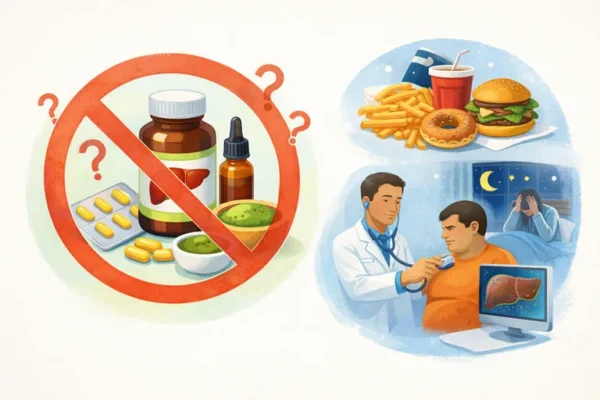
When There Is No Clear Liver-Related Issue
In generally healthy individuals with normal lifestyle habits and no signs of liver stress, supplements rarely provide noticeable benefits.
The liver already performs its functions efficiently, and adding support without a specific need often results in no measurable change.
When Lifestyle Factors Are the Real Bottleneck
Supplements cannot compensate for ongoing habits that consistently overload the liver.
- Regular heavy or frequent alcohol consumption
- Chronic overeating or highly processed diets
- Severe sleep deprivation
- Minimal physical activity
In these cases, addressing the underlying behavior usually produces far greater improvements than any supplement.
When Expectations Are Unrealistic
Liver supplements are sometimes taken with the expectation of rapid “cleansing” or dramatic changes in how one feels.
This is rarely how they work. Most effects, when present, are subtle and gradual. If the goal is a quick fix, supplements are likely to disappoint.
When Multiple Supplements Are Already Being Stacked
Adding liver support products on top of an already complex supplement routine often increases complexity without clear benefit.
- Overlapping ingredients may strain the same metabolic pathways
- It becomes difficult to identify what is helping—or causing issues
- Side effects are harder to trace
In many cases, simplifying rather than adding produces better outcomes.
When Liver Markers Fluctuate for Non-Liver Reasons
Changes in liver-related blood markers do not always reflect a liver problem.
Temporary fluctuations can occur due to exercise, illness, medications, or metabolic changes. Using supplements without understanding the broader context may be unnecessary or misleading.
When Medical Conditions Require Professional Management
Supplements are not substitutes for medical evaluation or treatment.
In individuals with diagnosed liver disease or those taking medications heavily processed by the liver, unsupervised supplementation may complicate management rather than help.
When “Natural” Is Assumed to Mean Risk-Free
Herbal and nutritional products can still interact with medications or affect liver enzymes.
Assuming safety based solely on natural sourcing is a common mistake and a reason some people should avoid supplementation altogether.
A More Practical Way to Decide
Liver supplements tend to make the most sense when there is a clear rationale: identifiable lifestyle stress, metabolic imbalance, or a specific supportive goal.
When those factors are absent, restraint is often the more evidence-based choice.
Understanding when supplements do not make sense helps avoid unnecessary complexity and keeps attention focused on habits that consistently matter more.